Since BBC Sherlock was released in 2010, the world erupted and fell in love in Benedict Cumberbatch and his role as the name entails, the eccentric detective Sherlock Holmes. Fans were attached to the friendship that was forming between Sherlock Holmes and his assistant, previous army doctor John Watson. With that, fans speculated whether what shown on the television screen was more than it was – that the way Sherlock looked at John was more than a friend. Tumblr and AO3 (non-profitable fanfiction site) became the main platforms of revealing multitude of fan theories and what the relationship between Sherlock Holmes and John Watson actually entailed.
Throughout the speculations there has been one thing for certain – the directors of the show Mark Gattiss and Steven Moffat have both commented on the fan theories by saying that Sherlock is NOT gay and the same goes for John Watson.
But then what drives all the fans to assume that Johnlock is a thing and not just their overly active imagination to meet their desires?

Well, if one was to watch all the 4 seasons of BBC’s Sherlock, there are more than few implications that there is more than just a bromance between the doctor and the detective. This has also led fans to accuse the writers of the show of queerbaiting.
Queerbaiting is advertising a homosexual relationship or possibilities of it in mainstream media through language or social queues and never acting upon it. More than one show has been accused of using queerbaiting as the means of attracting more LGBTQ+ viewers to boost their ratings but few have admitted it (Rizzoli & Isles) and denying the implications of gay sub-text as it has been in the case of Gatiss and Moffat.
Tumblr user nikkiaino posted a 6-panel comic to present their thoughts on the matter:
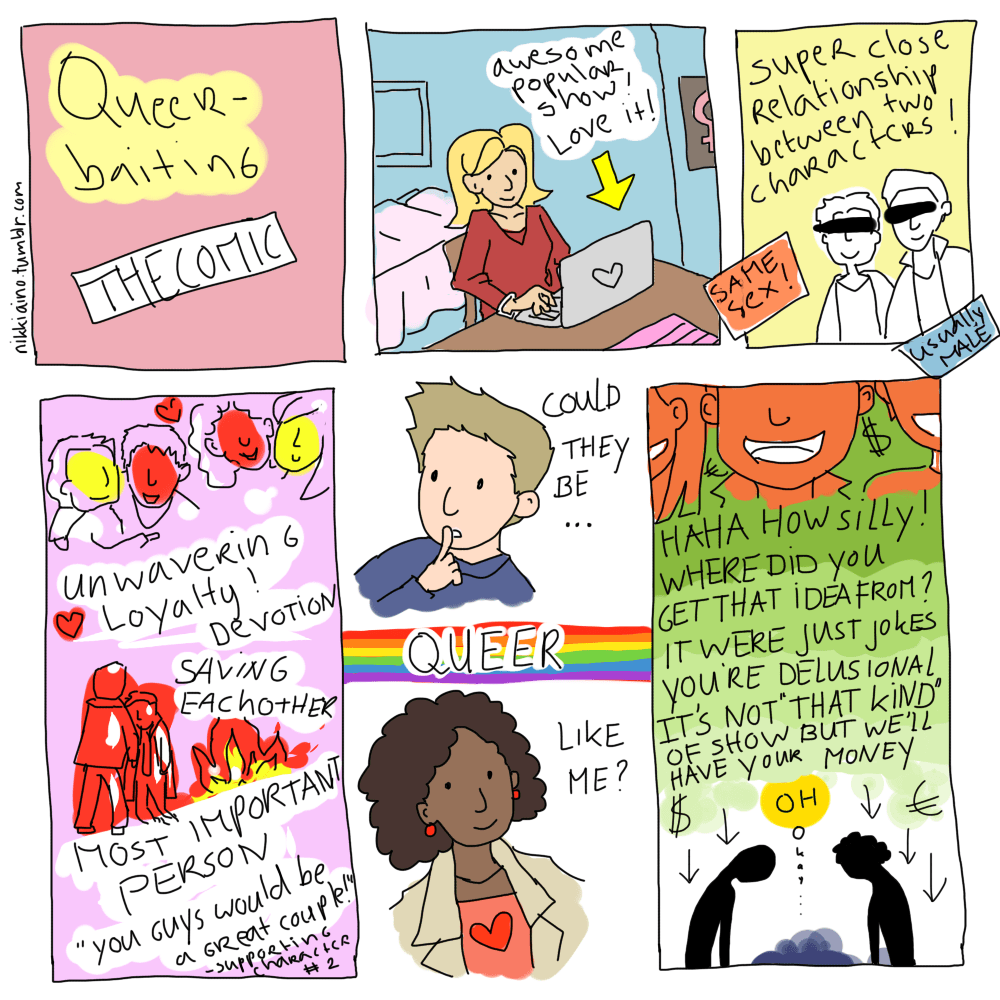
Not to confuse with hoyay says Brennan (abbreviation from homoeroticism, yay! – term for celebrating homoerotic subtext), queerbaiting has become harmful in the sense of homosexual relationships not being widely represented in media. Writers of the shows lure in their queer viewers by staying in the middle – hinting on queer relationships – but by catering to their main audience (heterosexual audience), deny any implications, comments, theories etc.
Going back to BBC’s Sherlock, what has appeared odd is the way writers and actors of the show have shared their opinion, contradicting themselves in many ways.
In an interview with Mark Gatiss in 2010, says: “I find flirting with homoeroticism in Sherlock much more interesting.” In another interview he states: “We’ve had lots of fun with the notion that, in the 21st century, people naturally assume they are a couple. The stuff that people really enjoy is the relationship between them. The banter and the rows and the proper feeling between them, which really leaps off the screen.”
And it has not only been Mark Gatiss, Martin Freeman has also commented that Sherlock is “the gayest story in the history of television.”
Moffat, the lead writer of the show on the other hand has denied the fan theories and speculations by saying “Holmes is not gay.”
It does send mixed signals to the avid queer followers of the show.
If we looked at queerbaiting from the show’s perspective rather than the writers’ and actors’ comments, there is visual representation of both John and Sherlock ‘acting gay’ if to look from the perspective how relationships develop if it was for example a heterosexual relationship.
A redditor youth_nolonger made a post about many of the romantic tropes that appeared on the show.
If we were to look at the show through TV tropes, one that mostly stands out is Everyone Can See It – a trope where every other character of the show except the main characters see a relationship between them, to put it simply.
Throughout the show Holmes and Watson have been mistaken in being in a homosexual relationship – writers have been aiming for comical relief but it does not happen only few times to just come off as that.
From the perspective of the viewers, how could the landlady Mrs Hudson think that after years of seeing Sherlock and John around, they are in a relationship. It makes more sense when she thought that in the beginning when John moved in to 221B Baker Street. But years?
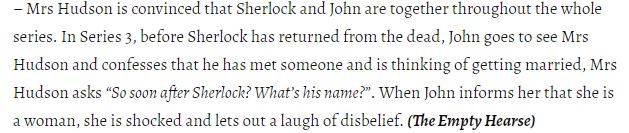
To add to it, a review of season 3 by Digital Spy wrote on the absurdity of the notion.
Going along with other romantic tropes Cry Into Chest – usually depicted after a traumatic event where one character breaks down and is embraced by the other character as they cry.
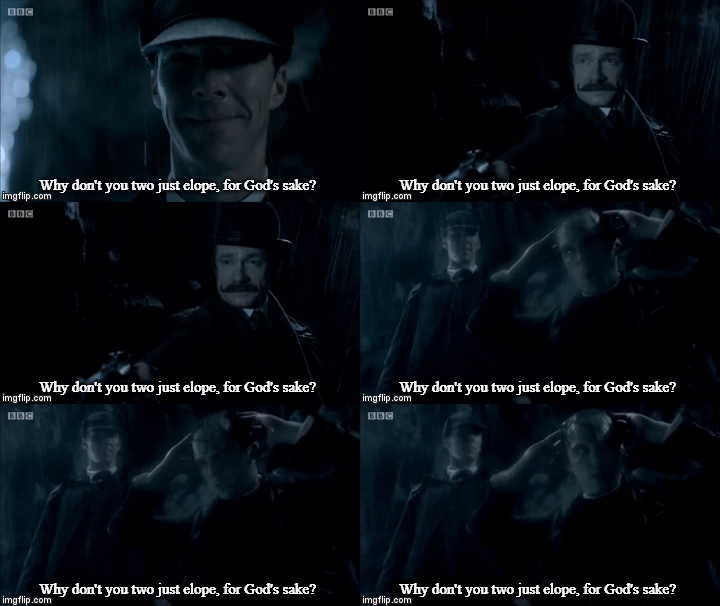
Or for example in a Sherlock Christmas special the Abominable Bride, where John saves Sherlock (trope Rescue Romance) and in the presence of Moriarty start bickering.
A behaviour such as baiting the queer community into watching their shows leaves most of the LGBTQ+ viewers frustrated and annoyed. Many have found that, yes – queer people are out there, they are real, but they are not real enough to be relevant on television. There is enough representation to get them hooked on the show but not enough to actually represent them. As previously mentioned, the trope Every One Can See It – is most of the time used by writers as a comical relief. Is that supposed to make being queer hilarious to the audience?
LGBTQ+ community has enough awful representation in television such as getting killed off or a queer couple ripped away from one another in the most tragic way you could imagine. Bury Your Gays is not just any TV trope, it has been around since 19th century after all.
List of hyperlinks:
https://www.urbandictionary.com/define.php?term=Johnlock
https://www.buzzfeed.com/skarlan/rizzoli-and-isles-admits-to-playing-it-up-for-the-lesbian-fa
https://groovymutant.wordpress.com/2019/06/20/romantic-tropes-and-queerbaiting-in-bbcs-sherlock/
https://journals.sagepub.com/doi/10.1177/1367877916631050
https://www.telegraph.co.uk/culture/tvandradio/8987425/Holmes-and-Watson-just-good-friends.html
https://ew.com/article/2015/03/30/sherlock-gay/
https://tvtropes.org/pmwiki/pmwiki.php/Main/EveryoneCanSeeIt
https://groovymutant.wordpress.com/2019/06/20/romantic-tropes-and-queerbaiting-in-bbcs-sherlock/
https://www.digitalspy.com/tv/cult/a539778/sherlock-series-3-premiere-the-empty-hearse-recap/
https://tvtropes.org/pmwiki/pmwiki.php/Main/CryIntoChest
https://tvtropes.org/pmwiki/pmwiki.php/Main/RescueRomance
https://meaww.com/what-is-queerbaiting-supernatural-lgbtq-community
https://tvtropes.org/pmwiki/pmwiki.php/Main/BuryYourGays
References:
Brennan, J. (2018, March). Queerbaiting: The ‘playful possibilities of homoeroticism. International Journal of Cultural Studies, 21(2). Retrieved from: https://journals.sagepub.com/doi/abs/10.1177/1367877916631050?journalCode=icsa
Fathallah, J. (2014, July). Moriarty’s Ghost: Or the Queer Disruption of the BBC’s Sherlock. Television & New Media, 16(5). Retrieved from: https://journals.sagepub.com/doi/abs/10.1177/1527476414543528?journalCode=tvna
Nordin, E. (2015). From Queer Reading to Queerbaiting: The battle over the polysemic text and the power of hermeneutics. (Unpublished doctoral thesis). Retrieved from: http://www.diva-portal.org/smash/record.jsf?pid=diva2%3A839802&dswid=-1193
 828734